The Paama Properties
by Anton Zuiker on October 2, 2026
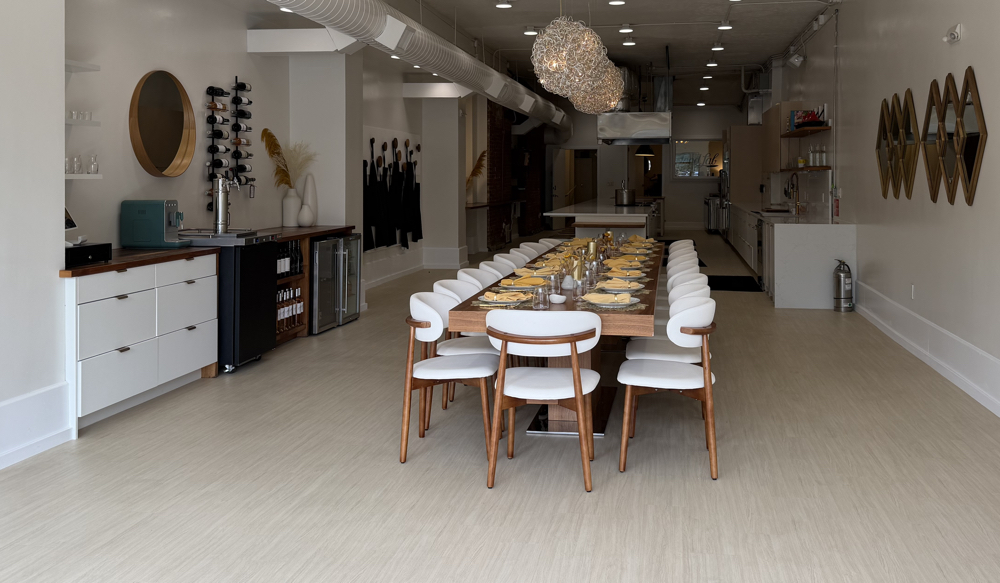
FoodLab in Boulder, Colorado, hosts cooking classes, team building, & private events
A week ago, I was sitting outside the Creature Comforts cafe on Pearl Street in Boulder, Colorado, with a few hours to roam until I could pick up my bib number and finisher t-shirt for the Boulderthon half marathon. I’d come from my cousin Justin’s house in Denver on the Flatiron Flyer bus, walked to Boxcar Coffee Roasters for coffee and yogurt (and peeked inside FoodLab next door), then taken a few more steps to this cafe. I was relaxed, comfortable in the cool morning air, enjoying the people watching, and open to inspiration by the record store across the street, the mountains behind the city, and a big decision I’d just made.
In December 2026, I will retire from Duke University, where I’ve worked for 19 years as a medical, science, and research communicator.
The Duke School of Medicine has been a good place for me to grow as a writer, project manager, and team leader. I’m proud of what my colleagues and I accomplished, first in the Duke Health news office with improvements to the Inside Duke Medicine newspaper and then in the Department of Medicine with our communications strategy and the Voices of Duke Health listening booth and podcast. In the DCRI Research Communications & Engagement department, I’ve spent the last six years partnering with a talented team supporting large national research networks. DCRI gave me the space to dive into coaching and learn to be a curious and supportive leader.
That curiosity was sparkling in the mountain air.
Erin and I had determined that my retirement would allow me to become ‘director of special projects’ at home, meaning I’ll lean into the cooking, cleaning, shopping, appointments, and other household needs. That will give Erin more time to focus on her successful law practice (and explore her own future goals). We also decided that Paama Properties, a small LLC we started years ago to manage a rental house, offered a fertile ground to grow some of our ideas. We’d named that company for the small island where we had served as U.S. Peace Corps Volunteers in the Republic of Vanuatu in the South Pacific.
On Paama, we lived in Liro Village, where we learned different styles of communication—we spoke Bislama, the lingua franca of Vanuatu, and a little Paamese, and we used nonverbal cues such as eyebrow flickers to indicate a ‘yes.’ Most importantly, we learned the joy of sitting with others under the mango tree for long conversations, what ni-Vanuatu call storian. (In Hawaii, where I lived after college, they call this ‘talk story.’)
As an early blogger and adopter of social media, I built on this Paama Peace Corps service to organize online communities through face-to-face activities, including BlogTogether meetups and the annual ScienceOnline participant-driven conference. During my ‘decade of narrative’ to nurture connection and community, I put on Talk Story storytelling shows, hosted The Long Table culinary events, and created Voices of Duke Health. Retirement will offer me an opportunity to continue this thread of community gathering, conversation, and storytelling.
This thread, I noticed while sitting at that outside table in Boulder, wore a name: The Paama Properties. Ta-da. A shift in meaning, from properties as parcels to properties as elements, crystallized my past service and future retirement goals and expressed what Erin and I always have wanted to give back to the world, Paama Properties as a means to bring people together over meals and storian.
By the time my coffee cup was empty, I’d drafted a two-page business plan to guide The Paama Properties, with a magazine, more meals, a new listening booth, and more. Details and invitations to come.
Coda
My cousin Jennifer ran the Boulderthon full marathon, and the course allowed us to run side-by-side for the first 10 miles. Her brothers Justin and John, and their families, and Aunt Elaine, and Uncle Terry and Aunt Riggs down from Cheyenne, were all at the finish line when she ran across. An amazing family affair full of love and hugs to celebrate her accomplishment. Uncle Dennis, who died last November, was most definitely there in spirit.
Out on a limb
by Anton Zuiker on September 7, 2026
Today on the way back from a weekend road trip to Atlanta, where Oliver joined a gathering of his summer-camp friends, I listened to three mesmerizing podcast episodes that serendipitously overlapped with recent conversations and themes I’ve explored.
On Coaching For Leaders (Four Words That Set Successful Leaders Apart), host Dave Stachowiak explains the four words that he says differentiates leaders who thrive from those who don’t. The first two words, he says, are ‘show up’ which echo the Ted Lasso message I blogged about last night.
On The Daily (Classical Music Is in Crisis), host Michael Barbaro and NYTimes classical music critic Joshua Barone discuss the excitement and change that superstar conductor Gustavo Dudamel brings to the New York Philharmonic as he starts as music and artistic director this week. A few nights ago, my friend Michael and I were at Sharp 9 Gallery in Durham for live jazz. On the drive there, I told Michael about a high school friend, Rob Deemer, who was a talented musician and budding conductor. Rob contributed a musical score to the New Pennis literary magazine I edited and then invited me to juggle as he conducted his senior arrangement.
On The Ezra Klein Show (The Tao of Rick Rubin), a rerun of the 2023 conversation with the amazing Rick Rubin had me near tears. So much of this, about Rubin’s book about creativity and way of living, reflected what I’ve experienced in my beginning journey into mindfulness these last few years, and even longer. Ezra opens with a reference to the Stephen Mitchell translation of Tao Te Ching, a book I bought in 1991 in Columbus, Ohio. My friend Joe was in the bookstore with us, and yesterday Joe in Cleveland texted me as I wandered the food hall of the Ponce Leon Market in Atlanta.
Rubin also says this:
So there’s a belief and a suspension of disbelief that goes into all of the creation of art. If you want to make something new, there’s no template to follow. We’re really going out on a limb all the time. And we crash and burn a lot. We crash and burn a lot in the process, just hopefully not too often on a grand stage.
But the beauty of it is when we’re making things, we’re making them for us. And then it’s up to us to say, OK, this is something I want to share with other people, or this is something that not only do I not want to share with other people, this is telling me I want to go in this completely different direction because I found this is more of a dead end than I expected.
That’s the same vein of gold that Paul Millerd tapped in The Pathless Path, to go and make something. But the concepts of being out on a limb, and getting to a dead end, and crashing and burning, have been on my mind. Looking back over the course of my career, and mining my blog posts, I’m noticing a lot. Such as? Such as that high school literary magazine I lead, the embarrassment when half of the pasted-up pages got ruined by rain that came through my family’s apartment window, but also pride about our creative decision to put classical music across a spread of pages.
Perhaps I should start a magazine.
A different path
by Anton Zuiker on September 6, 2026
Three books I’ve finished recently have caught me in a reflective mood, at an important pivot point in my life.
Craig Mod wrote Things Become Other Things: A Walking Memoir about walking the ancient pilgrimage paths of Japan’s southern Kii Peninsula and how that helped him understand a childhood friendship. Back in June, I took an impromptu mid-week road trip to Asheville to hear Craig read from the book. Back home, I slowly read my copy on the porch with my morning coffee, savoring Craig’s introspection and observation.
I also restarted my membership in Craig’s Special Projects and have been reading (and occasionally contributing to) the inspiring conversations in the members-only discussion board, where every day there are examples of individuals around the world sharing the creative paths they are on, such as Luis Mendo and Swati Singh.
Here’s Paul Millerd, author of The Pathless Path explaining what he’s learned by walking his own way:
Through reflection, I was able to see that there was a larger ‘conversation’ I was meant to have with the world.
His is a memoir, too, and a way for him to share the lessons he learned and satisfaction he found by getting off the default corporate, full-time-job career path. (I paid for the premium hardcover version of the book, and it was worth every dollar. Also, he quotes as many women as men.) He encourages his readers to figure out what you have to offer, pause and disconnect, and go make something. All timely suggestions that hit on what I’ve been doing over the last few years or what I’m planning to do in the year ahead.
David O’Hara, a philosophy and classics professor who I follow on Micro.blog, co-wrote a book about trout fishing. In Downstream: Reflections on Brook Trout, Fly Fishing, and the Waters of Appalachia, O’Hara and Matthew Dickerson describe the many times they have waded into a river to cast hand-made flies of one type or another, and the feeling of awe and wonder that comes from the dance with the fish.
What especially caught my attention was when O’Hara writes, “I also am in the habit of walking long distances in streams. If I can get in the stream at a public access, I’m willing to stay in the stream for miles in order to get to the good fishing, and to defend my right to stay in the stream to anyone who challenges me.”
I’ve only walked in a stream like that once, and not with a fishing pole—my summer job in college was on a rich man’s farm, and one day we had to walk more than a mile of the stream to clear it of decades of debris. Still, David’s quote prompted me to remember the career/life strategy I have espoused:
I see my life as a river crossing, with my career/life goal set on the far riverbank, and many stepping stones in the river. At times I step to a stone that puts me closer to the riverbank; other steps are lateral. This philosophy combines two lessons my parents taught me – to have a goal, and to make the most of any situation.
David got me thinking again about my personal philosophy. Was my crossing-a-river focus the same as Millerd’s default path? Have I been stuck in this perspective in which I have to get to the other side of the river? Not really, but also, maybe a bit. As it happens, I’ve reached an important career milestone in my river: the Rule of 75 means that now I am eligible for health and child tuition benefits in my retirement. As you might surmise, that’s a big rock on which to pause, look around, and decide where I might go next, including in new directions, further, farther.
It’s ok to wander
The word embarrassment came up this week, in Pathless Path and Ted Lasso (indeed, the episode, S4E5, was titled Riches of Embarrassment).
Paul: “Even if you do decide that sharing your real work with the world is worthwhile, it’s nearly impossible to overcome the sense that you may embarrass yourself. Here it’s helpful to remember the ‘spirit of the fool’ and also consider that many people around the world might be waiting for what you have to share.”
Ted: “Embarrassment. An emotion so useless it should be embarrassed of itself. And yeah, it can trap any of us, keep us small, scared, until we bust out of it.”
An even more powerful statement from that same episode was when glove-less goalie Boots tells Keeley, “Those voices in your head, tell them to shut the fuck up, all right?” Also, that little girl who gets to scream into the microphone, “Where the fuck are you?” Show up is the half-time message, though that could very well be the best life career/philosophy ever.
Meanwhile, the word aimless came up in two conversations, both in reference to individuals or organizations that seemed to have lost their way. Perhaps they are, but tonight I for one am feeling inspired to wade in and wander.
Bookmarks and notecards
by Anton Zuiker on August 20, 2026
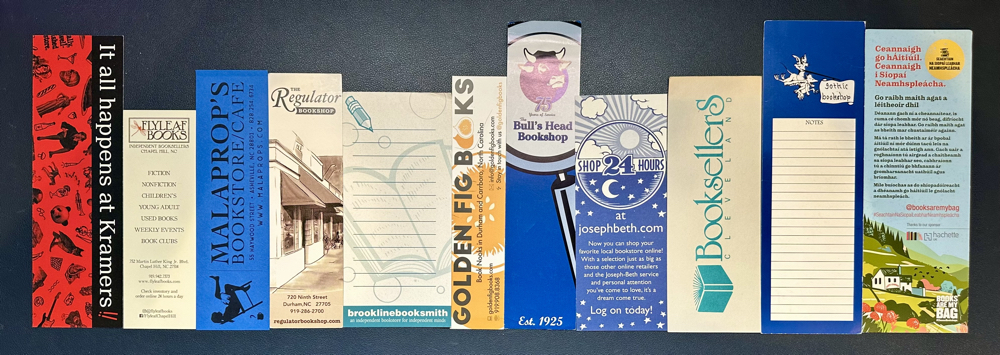
Bookmarks I've collected through the years.
I stopped into my local bookseller, Flyleaf Books in Chapel Hill, to pick up my latest special order (Do Blue: Water, waves, and wellbeing, and Downstream: Reflections on Brook Trout, Fly Fishing, and the Waters of Appalachia). As usual, right there on the counter was the jar of free bookmarks, and Flyleaf’s are one of the best I’ve collected in 40 years, perfect size and paper weight, color and text not distracting when I open to where I have left off in whatever book I’m currently reading.
A few years ago, I saw that Evan Calkins and his partners at Hoban Press had printed bookmarks of their own. I remembered that back in January when I determined I would try to be a better gift giver this year. Since I like giving books as gifts, I figured I could get my own bookmarks printed and then include one with each gift.
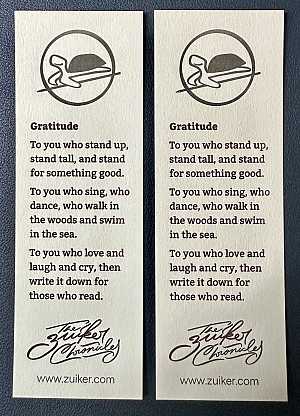 So, I wrote a poem of gratitude (to the writers and others who educate and entertain us), sketched a design for a bookmark, and worked with Evan to adjust the Zuiker Chronicles logo for the vintage letterpress that he uses to print business cards and stationery. Now I have a big stack of quality bookmarks to give away.
Along with the bookmarks, I had Evan make a stack of heavy notecards with just the turtle printed as a blind impression; that is, no ink and just the shape of the logomark pressed into the heavy paper. This makes for a plain white card with the most subtle of marks. I love it, though when it comes time to reprint I’ll get it in one color to make it pop. I’ve been writing notes to friends and family, and to colleagues I meet for coffee.
Today I got this email from one of those colleagues:
Thank you for your kind handwritten note—an art form I love and wish more people would keep alive.
Thirty reasons to smile
by Anton Zuiker on August 10, 2026
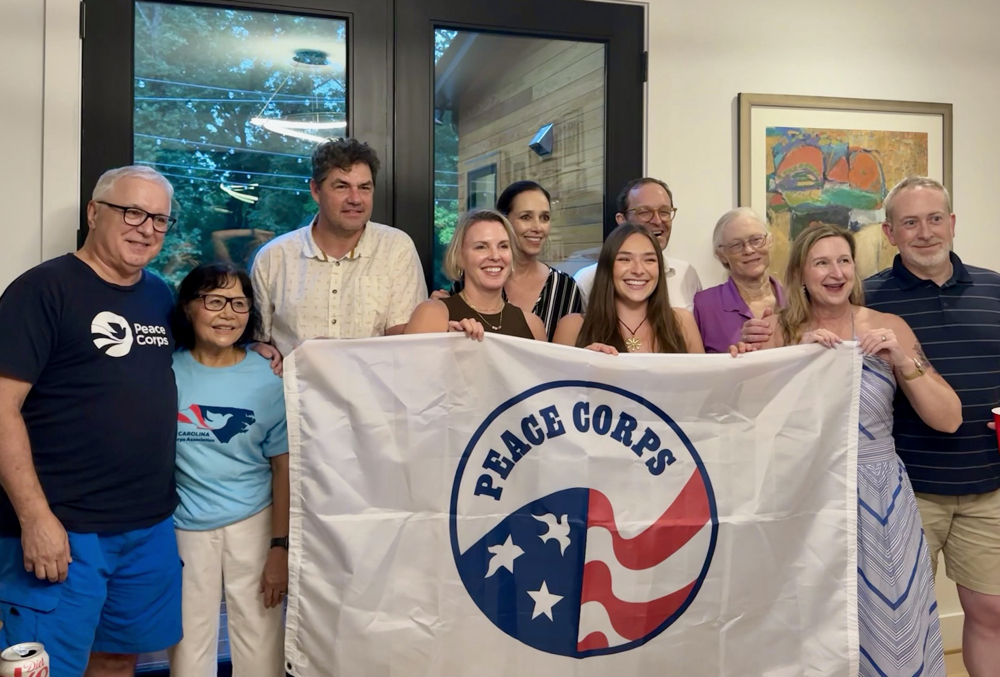
Returned Peace Corps Volunteers with Malia, soon to serve
It’s our anniversary today, 30 years since Erin and I exchanged vows (‘grow up and grow old with each other’) in front of our family and friends inside the St. Francis Chapel on the campus of John Carroll University. Here’s how we celebrated:
Last month, Erin and I returned to Acadia National Park. It was fun even though I got sick (the lab tested me for every diarrheal illness possible except for cyclospora, the one in outbreak across the state; negative for all the others so I’m sure I had it).
On Saturday, we hosted nearly a hundred of our friends and neighbors here in our house for a celebration of Anna, who started her first job as nurse today, and for Malia, who graduated from American University in May and leaves next month for Peace Corps service in Guatemala—Malia will be the third generation Zuiker to serve! and we gathered all the RPCVs at the party for a group photo (above, would have been outside but for the heavy rain that was falling; we served in Nepal, Moldova, Guatemala, Morocco, Vanuatu, Benin, and Mali).
Tonight, Oliver got his first varsity start for the Carrboro High School boys soccer team. We watched him play well and the team win.
We returned home and retreated to the patio for pizza under the umbrella, with mosquito coils smoldering nearby adding an olfactory memory of Vanuatu and the Virgin Islands. A young owl, and then its parent, added their calls to the constant song of the tree frogs. Erin and I read lovely notes from our children expressing their admiration for our long-lasting relationship. Then we dipped into the hot tub and soaked under the stars.
All in all, a splendid day reflecting a deep love, a relationship we’ve worked at, a family we’ve loved, a community that’s supported us, and a world that’s amazed us.
I love you, Erin. Thank you.
Trail connections
by Anton Zuiker on July 17, 2026
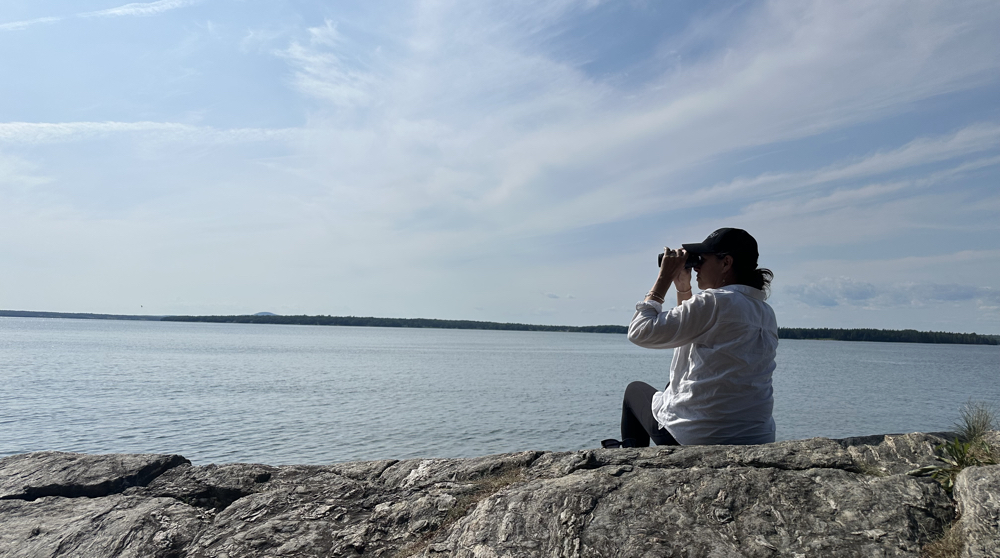
Erin tracking seals off Indian Point, Nature Conservancy's Blagden Preserve, Maine
Last week, Erin and I were back in Maine to celebrate our 30th anniversary.
We had honeymooned on Mount Desert Island and in Boston in 1996, and when a special trip to Portugal seemed too hard to shoehorn into this summer’s busy schedule of Oliver at summer camp, a big landscaping project, and Anna preparing to move to her first nursing job, we landed on a return to Acadia National Park. Our spring break glamping in Zion earlier this year was so much fun that we decided to book another tent at Under Canvas Acadia and then two nights at the posh Longfellow Hotel in Portland.
Seeing things
I have an insatiable need to make connections and find shared interests with others, so, naturally, I was looking not just at the rocky path and stunning views but also at the other people on our first hike up the strenuous St. Sauveur and Acadia Mountain Loop.
A pair of hikers were coming down the trail while Erin and I were climbing and I noticed a familiar design on the woman’s shirt. I instinctively said, “RUN DRM, I have that T-shirt.” They stopped to explain that the man grew up in Chapel Hill and the two live, and run, in Durham.
Erin and I kept hiking.
Where did 30 years go? we wondered. We talked about our travels around the globe, raising a family, developing our careers, “growing up and growing old together” (from our wedding vows). Here we were in Maine again, with time and health and resources to revel in our relationship. As I felt on our honeymoon and every day since, I was grateful, and in love.
Later, we reached the panoramic Acadia Mountain summit marker. Other hikers were paused there, one woman wearing a hat with the word Carolina both upside down and backward. What’s the meaning of that? I asked her. It was a promotional hat for the Carolina Blaze, a professional women’s softball team that plays in the Smith Family Stadium on Duke’s campus. I live in Chapel Hill and work for Duke. Small world, this trail.
I was feeling proud of my ability to notice what I’m noticing and to engage others.
By now, though, I also was feeling hot, thirsty, and a bit light-headed. I worried that I was still out of shape from my six-week recovery from the broken toe, but I’d played soccer the previous week and I seemed to be hiking just fine. The next day, though, I knew I wasn’t well, with a stomach bug that’s still with me a week later (my doctor will run a test for cyclosporiasis). I did my best to push through the rest of our hikes and meals, but I did backtrack, smartly, at the start of the steep Beehive climb because I sensed I was faltering and Erin saw me stumbling.
 Anyway, I’m standing off to the side while Erin is asking the group for local dining recommendations, and a tall hiker looks at me and asks if I am into typography and web design.
I was momentarily confused (still hot) but then I realized he was referencing the hat I was wearing, KERN. I explained that I follow the typography work of Dan Cederholm of SimpleBits and I have my own website using Textpattern and one of Dan’s fonts. The tall hiker listened to me ramble, then mentioned he was the creator of an open source CMS called Drupal.
Erin was listening now. “Do you know Drupal?” she asked me.
“Of course! Many of the websites at Duke University run on Drupal.”
I looked back at the hiker. “So you’re ….” I started to ask.
“Dries Buytaert,” he finished.
I was tongue tied (still dizzy!) and as I searched my memory for the first time I encountered Dries on the web, Erin ribbed me about being a fanboy, which was true, because I’ve admired all the developers of the blogging software I’ve used over the last 25 years: Noah, Evan and Meg, Ben and Mena, Matt, Rick, Dean, Dave, Dries, Manton, and others.
Standing there on the side of the mountain, we chatted about blogs, RSS, design, and the World Cup. Belgium would be playing the U.S.A. later that day. Dries is a great blogger with an excellent domain—dri.es; see his photo post, on this page, about how his friends congratulated him on Belgium’s decisive victory. Erin and I watched that game on her iPad in our tent, and I was still smiling about my interactions on the trail.
We watched other matches along the way, including the second half of the thrilling Egypt-Argentina game in the Tap & Barrel Tavern (delicious beet salad and the Amber grilled cheese sandwich) and the France win over Morocco in the Rí Rá Irish Pub in Portland.
So, even through my dizzying nausea, lots of highlights to the week. The pinnacle, of course, was that I was alongside Erin, my hiking and life partner of 30 years.
Extras
- We also hiked sections of the steep Gorge Path and Cadillac South Ridge Trail, Great Head Trail, and the Indian Point-Blagden Preserve. We ate popovers on the grass at Jordan Pond House, too.
- At Under Canvas, happy kids ran around as we roasted marshmallows and a momma porcupine ignored the commotion to munch on grass. One night, her baby appeared briefly. A baby porcupine is a ball of cuteness.
- The Portland restaurants Chaval (‘Spanish and French-inspired cuisine meets the flavors of the Maine coast.’) and Duckfat (‘Belgian-style frites, hand-punched, twice-fried in duck fat.’) were excellent; we even returned to Duckfat a second day for more of the delicious tomato soup.
- I would have eaten more, and tried more beers, if I hadn’t been feeling so off.
- In Portland, we took the Casco Bay Ferry over to Peaks Island; Erin saw me struggling so quickly rented a golf cart so we could tour the quaint island. We also went for a sail on the schooner Timberwind.
- “In Typography, kerning is the process of adjusting the space between two specific characters, or letterforms, in a font. It is not to be confused with tracking, by which spacing is adjusted uniformly over a range of characters.” (From Wikipedia)
- The description of the KERN hat claims ‘This low-profile, embroidered hat demonstrates some absolutely terrible kerning, and is sure to be a conversation starter.’ Spot on, Dan!
- See my Wan Smol Blog for more posts and photos from the trip through Acadia and Portland, and then Rhode Island, where I spent a few days visiting my father and catching a show by The Heavy Heavy.
- See my Duke River of News to read what’s flowing through those Duke websites.
Appreciation
by Anton Zuiker on June 28, 2026
Last year on LinkedIn I posted an update about how I was benefitting from leadership coaching, therapy, orthodontia, time to read, and opportunity to play pick-up soccer.
Here’s what I wrote:
So far in 2025, I’ve gotten a promotion at work, redesigned my long-running blog, been in good health (scored two goals in pick-up soccer on Sunday!), finished reading a few novels and memoirs, and started most mornings with meditation and mindfulness.
All of this is in my personal ‘vivid vision’ that I wrote last year. That two-page document, which describes what I want to be doing and feeling on my birthday in 2030, was inspired by a business strategy book by Cameron Herold, but really the clarity and specificity in my vision document reflects the weekly coaching sessions I’ve had with Troy Livingston. Troy’s been a curious, kind, and steady coach. I turned to him when I needed help applying mindfulness to my work life. His questions and insights have helped me grow as a manager and leader.
During this same time, my therapist has helped me look deep, my orthodontist has aligned my teeth, and my stylist has made my longer hair look good.
There’s more that I want to do. Less, too. I’m grateful for Troy’s coaching to help me see the difference. If you are at a point in your career that you’re ready to craft a vision for where 2025 will let you grow, consider Troy (or another coach) to go there with you.
Completion
Recently, I decided to stop my coaching sessions with Troy. After more than two years, I had come to a feeling of completion. “You have graduated,” Troy said to me in agreement, and so we reviewed the span of our conversations and the trajectory of my professional growth and inner peace.
I shared a small example. Here at the house we have a backyard courtyard and landscaping project underway, and there’s construction dust coating everything. Our cars, too, are full of dust from the gravel driveway and dry conditions here in North Carolina. I bought a pack of soft microfiber towels and handed them out to the family. Knowing the benefit of keeping my eyeglasses clean (I always have a hank from GondekEDC in my back pocket), I recommended to the family that they use the towels to “clear the dust daily.” I mentioned this to Troy and he agreed it was both a good practice as well as a fine example of awareness and habit and striving for clarity.
This mindfulness is precisely why I asked Troy for his support in 2023. He helped me get here, and I am grateful for Troy’s support.
Troy is available to be your coach, too. Check out Troy Livingston Coaching & Consulting.
Legacy
As good coaches do, Troy asked me repeatedly, “How do you want to show up?”
He also asked me, “What do you want to be known for?”
I never felt my answers to Troy were adequate or thorough, but I’m glad for those questions. I will keep working at being better, being kinder, being calmer, listening deeper, loving longer.
Last week, Om Malik, an influential journalist and blogger and venture investor, died at the age of 59. Om was admired, respected, and beloved, and there are many tributes to him and his kindness to others, whether strangers or new friends or longtime collaborators. (John Gruber’s remembrance is one of most beautiful of the bunch.) What a life. What a legacy. What an answer.